
How to Search Criminal Dockets
Want to search a Transylvania County criminal docket? The statewide entry point is the North Carolina eCourts Portal. Its Smart Search tool reaches public Odyssey cases across the state, Transylvania included. Got a record number? Search it. Without one, run a party-name search. Then apply the Transylvania location filter. Add the Criminal or Infraction case type only when they fit. What comes back is a public Case Summary. It is sometimes called a Register of Actions, not the clerk's official court file.
Have the details ready first. The Portal wants last name, then first name, or a case number. A current Transylvania criminal number can follow the pattern YYCR######-870. The trailing 870 marks Transylvania County. Infractions use YYIF######-870. Treat both as format examples, not real references. Also note that Smart Search cannot find a matter by charge or offense alone.
- Open Smart Search in the eCourts Portal and enter a party name or record number.
- Use Advanced Filtering Options to select Transylvania and, if useful, Criminal or Infraction and a filing-date range.
- Open the underlined record number to read the public Case Summary or Register of Actions.
- Use Search Hearings with Transylvania, a hearing type, a search type, and a date range when the immediate question is the next setting.
- Confirm a missing, changed, or official-record question with the Transylvania Clerk of Superior Court.
Note: Filters by location, date, type, or status can narrow broad results. Use one that does not fit, though, and a matching record may stay hidden.
Transylvania Criminal Docket Search Limits
Smart Search will not take a charge name as a search term. The Portal lets you look up a Transylvania County case by party name, record number, citation number, attorney details, business name, cross-reference number, or nickname, but an offense description is not one of the routes. Typing a charge into the box proves nothing about whether the criminal docket exists. Find the case by name or record number first, then read the public case information to see what events the court recorded.
The Portal also caps any search at 200 results. A blank screen can mean a spelling or formatting slip, the wrong location, a filter set too tight, a restricted record, or simply no matching case you can reach. It never tells you an outcome. When the Portal cannot resolve a public Transylvania criminal docket, the clerk's public terminal, counter file access, and staff guidance are the official fallback.
Need a human? The Transylvania County contact directory gives the Clerk of Superior Court main number as (828) 885-3000. One clerk serves as the record office for both Transylvania Superior Court and District Court matters, so there are not two separate local offices to chase down.
For the ground rules, the Transylvania local rules and forms page posts the local materials that govern docketing and continuances in this county's courts.
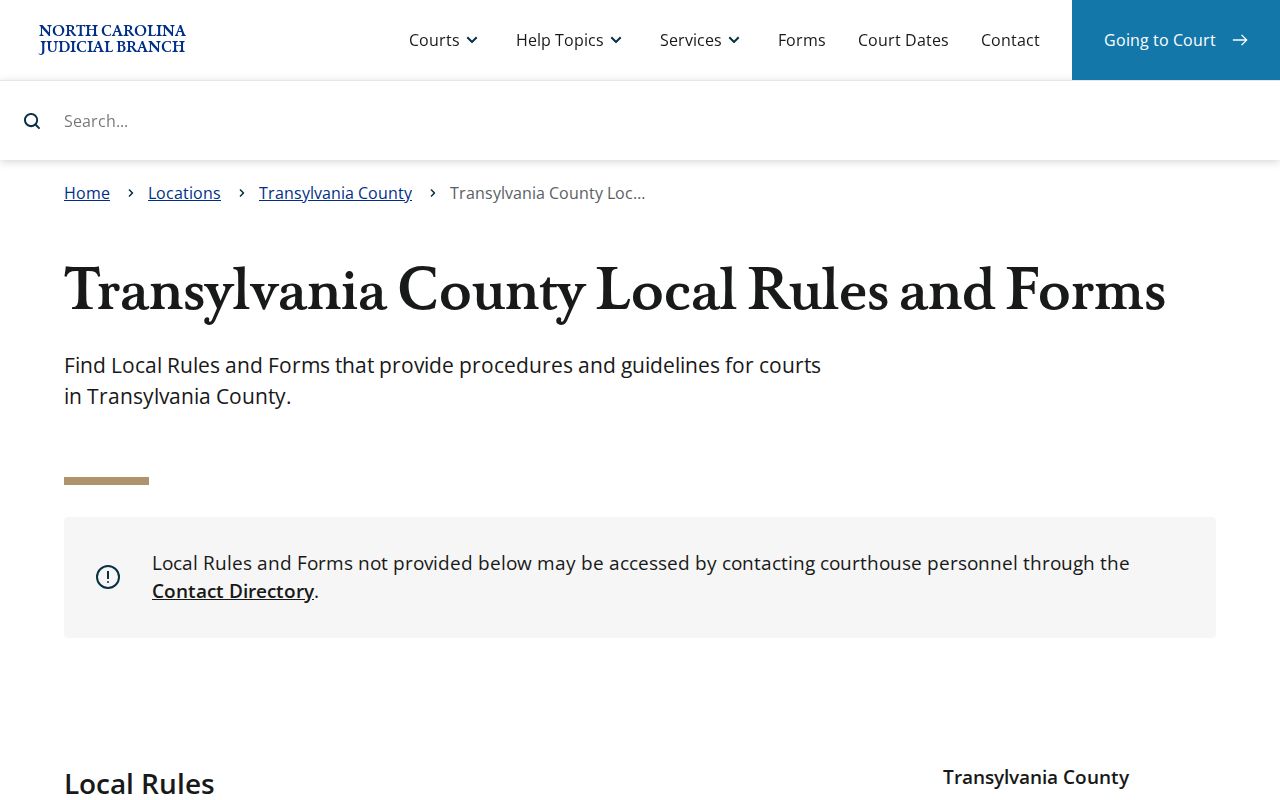
Local rules help you read scheduling entries, but they settle nothing on their own. A specific Transylvania criminal docket still needs its own Register of Actions, hearing result, notice, or clerk confirmation.
What a Criminal Docket Shows
Open a Transylvania County case on the Portal. You may see panels for Case Information, Assignment Information, public Party Information, Case Events, Dispositions, Hearings, Financial Information, and permitted records or documents. Which panels appear depends on the case and its status. A public listing proves an event was entered. It does not make every filing viewable. Treat the Register of Actions as a near-real-time summary of the Transylvania criminal file. It is not a certified copy of it.
| Record number | The Portal's case identifier, such as the format example YYCR######-870, used for an exact case search. |
|---|---|
| Case information | Recorded top-level details, including case type and status where the public record supplies them. |
| Case events | A chronological entry list that can include filings, hearings, orders, and other recorded events. |
| Hearings | Publicly scheduled or recorded hearing information; Search Hearings is the separate date-focused Portal tool. |
| Dispositions | Recorded outcome or procedural-status information when entered and publicly available. |
| Documents | Public documents when available. Sealed, confidential, or restricted material does not appear for ordinary public users. |
If a Portal screen and a paper notice disagree, the underlying Transylvania court file and the clerk's confirmation are what carry authority. An image of the screen is not a certified copy.
Which Court Holds Criminal Dockets
North Carolina runs one unified General Court of Justice. Criminal work therefore splits by division rather than by rival clerks. In Transylvania County, District Court takes misdemeanors and infractions. Superior Court takes felonies plus appeals from District Court misdemeanor or infraction rulings. Both divisions sit in District 42. The Clerk of Superior Court keeps every set of Transylvania criminal records, whichever division heard the matter. Need an appeal beyond that? The North Carolina Court of Appeals is the intermediate appellate court. It is not where an ordinary Transylvania trial-level case search should begin, though.
| Division | Transylvania criminal docket role | Useful search context |
|---|---|---|
| District Court | Misdemeanors and infractions, with limited magistrate criminal functions. | Use Criminal or Infraction filters and look for current hearing information. |
| Superior Court | Felony cases and appeals from District Court misdemeanor or infraction matters. | Check the criminal docket, administrative settings, and posted Superior criminal calendars. |
| Clerk of Superior Court | Custodian of files, dockets, indexes, and official court records for both divisions. | Use the counter, public terminal, or clerk contact for a public-file or certified-copy question. |
The Judicial Branch's criminal cases overview describes the state process behind those divisions.
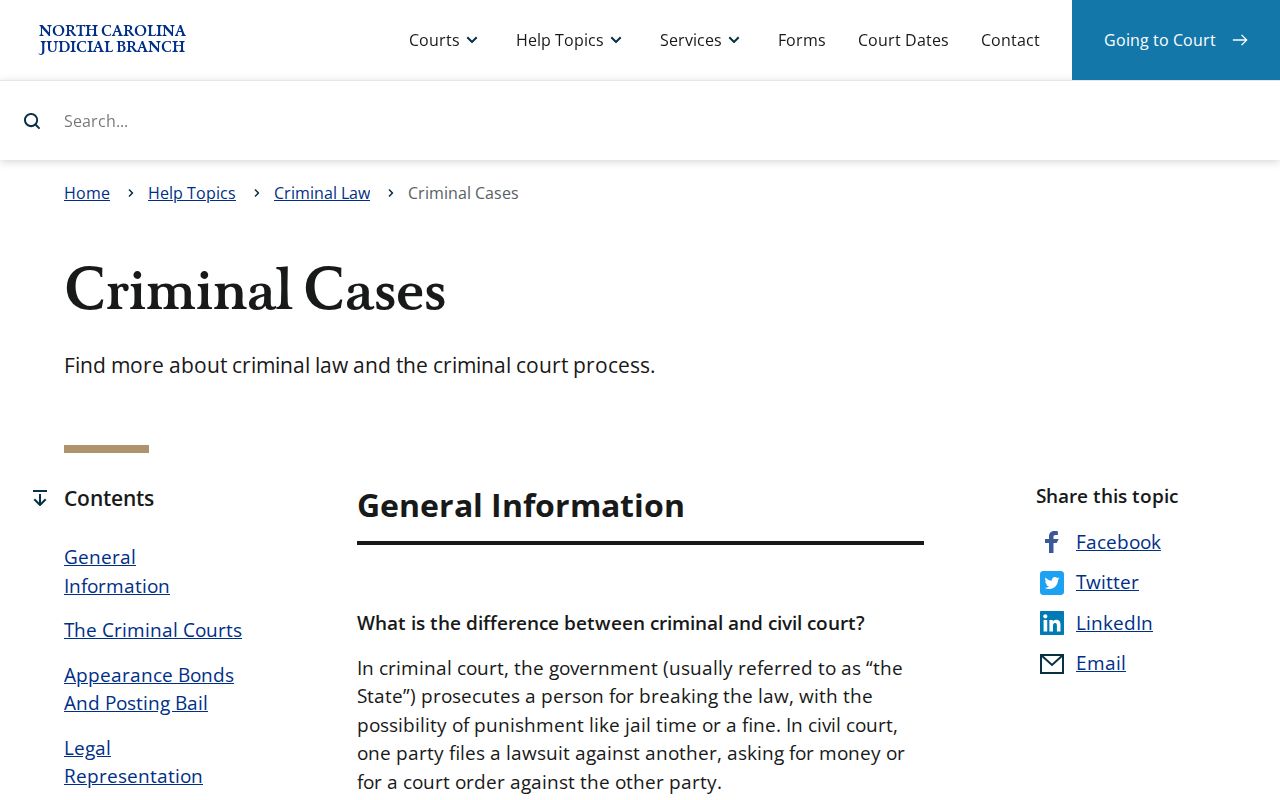
The division tells you how to read a Transylvania criminal docket and its case path. Either way, the same clerk structure remains the dependable route to the official local record.
Stages on a Criminal Docket
A Transylvania criminal docket may open with a District Court event, then show the case moving up to Superior Court when the charge type or an appeal calls for it. Entries open to the public can cover the filing, first appearance or arraignment, motions, hearing settings, and a disposition. Felonies follow a different schedule once an indictment lands. Under the local Polk and Transylvania plan, an indicted case goes onto an administrative calendar to sort out counsel, discovery and case status, notices, arraignment, and any pretrial motions that may follow.
Docket flow: Filing or charge › initial District Court event where applicable › indictment or transfer when applicable › administrative setting › plea or trial setting › recorded disposition.
A Portal status like Pending, Disposed, Archived, or Transferred to Superior Court is only a label. It is not the whole story. Check the related Transylvania criminal case events and disposition entries for the fuller picture.
Transylvania Felony Docket Settings
A felony case in Transylvania County often collects several dates before anyone picks a jury. The Polk and Transylvania Superior Court criminal docketing plan explains the sequence. Once a case is indicted, the district attorney should place it on an administrative calendar within 60 days or at the next scheduled term. Whichever the plan's fallback allows. Administrative settings are scheduling steps. The first date on the Register of Actions is rarely a trial date.
Statute adds its own timing. Under N.C. Gen. Stat. § 7A-49.4, a Superior Court criminal trial calendar must be published no later than ten working days before it begins. A trial ordinarily waits at least 30 days past the final administrative setting unless both sides waive that gap. So a string of Transylvania felony entries usually tracks the calendar process. It is not a settled trial date.
For day-to-day checking, use the county's criminal calendar results. They post District and Superior calendar files when available. Those files give court-level context. For the setting on a specific case, use Search Hearings, the mailed notice, or the clerk's office. The clerk also knows the calling order.
Transylvania Criminal Docket Status Labels
A status label on the Portal is only one piece of a Transylvania criminal docket. The labels you may see include Pending, Disposed, Completed, Archived, Remanded, Transfer to Another County, Transferred to Superior Court, Pending Expungement, and Voluntarily Dismissed with Leave. Each one records the case state as the Portal lists it. None of them tells the whole story on its own. A label alone will not spell out every charge. It will not cover every court action either. Nor will it explain why a case ended the way it did.
When a docket offers public Case Events and Dispositions areas, open them. Read the history behind the label. Bring official record questions to the clerk instead. Two labels deserve special care. Transferred to Superior Court signals a move within the state trial-court system. A closed disposition can still pick up later entries, such as financial ones, after the fact.
Transylvania Criminal Docket Clerk Check
Treat the public Portal as a reference layer only. NCAOC states plainly that its Case Summary/Register of Actions is not the official court record. For a Transylvania criminal docket, go through the Clerk of Superior Court. Ask there when you need it inspected, copied, or certified. The statewide court-records access information explains how clerk offices and public self-service terminals handle records. Criminal, civil, estate, and special-proceeding records are all covered.
The clerk's counter also helps with the hard cases. Old paper files, a document missing from public view, or an online access limit can all stall a docket search. Staff can tell you what may be inspected. They can also say whether a plain or certified copy is available. The Portal's Make Payments tool handles eligible criminal or infraction payments. Not every case qualifies. Paying online never extends a deadline. Filing users work through electronic filing in File & Serve. That is a filing channel. It is not a public criminal-docket search tool.
Portal and clerk have different roles. Smart Search helps locate a public Transylvania criminal case, while the clerk holds the official file and handles certified-record questions.
Public Access and Sealed Criminal Dockets
North Carolina law puts court files, dockets, and indexes in the clerk's hands. Public inspection is the baseline. That baseline holds unless a law, court rule, or order says otherwise. Even so, a home-browser search will not surface every Transylvania criminal docket item. The Portal keeps sealed, confidential, expunged, and restricted material out of ordinary public view. When a record is requested, the clerk steps in. The clerk applies whatever restriction governs it.
Key rules:
N.C. Gen. Stat. § 7A-109 requires the clerk to keep court files, dockets, and indexes and sets the general public-inspection baseline where law allows access.
N.C. Gen. Stat. § 7B-3000 makes juvenile delinquency and undisciplined-juvenile records nonpublic except as the statute or a court order permits.
N.C. Gen. Stat. § 15A-151 requires expunction records to be held confidentially except for limited authorized access.
Transylvania Criminal Docket Restrictions
Some records sit outside a normal public docket search. Juvenile matters and expunged records are two examples. An unreturned criminal warrant is another Portal restriction. Domestic-violence cases may be public, yet protected data elements can mean narrower online display rules for them. A public terminal or a clerk inquiry can confirm that a public record exists, but neither route opens sealed or confidential content.
The juvenile-records statute sets out the confidentiality rules that govern access to juvenile court records.
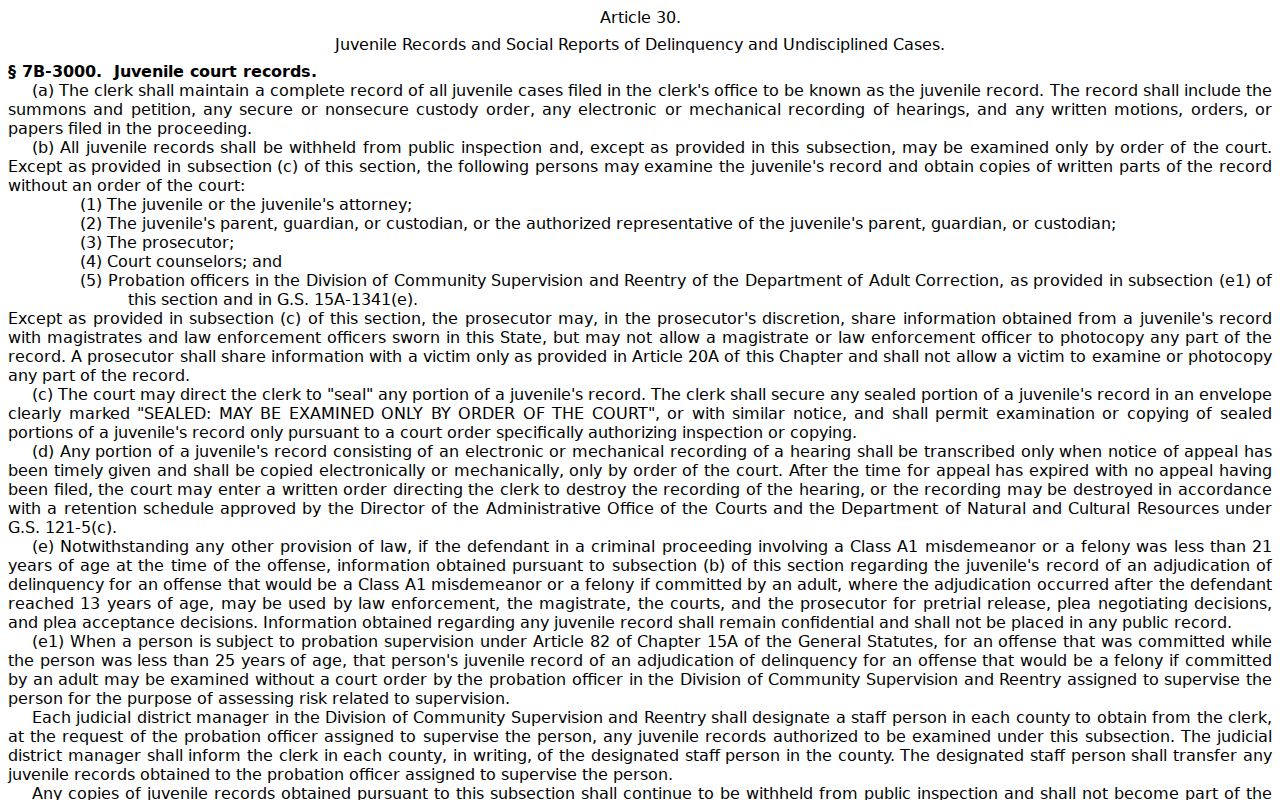
A Transylvania County criminal docket search runs into a statutory boundary that the official page spells out. When no public result appears, treat it as silence rather than evidence of a person's record.
Transylvania Criminal Docket Hearing Checks
Skip the posted calendar file at first. Go straight to Search Hearings for a current Transylvania criminal docket setting. Pick Transylvania as the county. Add the hearing type the Portal supplies, a supported search type, and a date range. Once the individual hearing result is in hand, the criminal calendar file adds session-level context for District or Superior Court. That file supplements the result. It cannot replace mailed notice. The hearing result itself and whatever the court tells you directly still govern.
A conflict between a hearing search and a mailed notice goes to the Clerk of Superior Court. The Portal guide is clear that the courtroom clerk sets calling order, not the sort order of a result grid. So the public docket establishes a date. The sequence in which cases get called is another matter entirely.
Transylvania Criminal Docket Expunction Limits
Once a Transylvania County criminal case is expunged, it drops out of the ordinary public Portal. The clerk's court files are covered too, not just the search display. Only the limited statutory access named in the law gets through. Remember that a no-result has many possible causes. The search format may be off. The case may sit in a different location. There may be no responsive public record, or a restriction may apply. A blank screen is never proof of expunction or of how a case concluded.
The official expunction-confidentiality statute sets out exactly where that limit comes from.
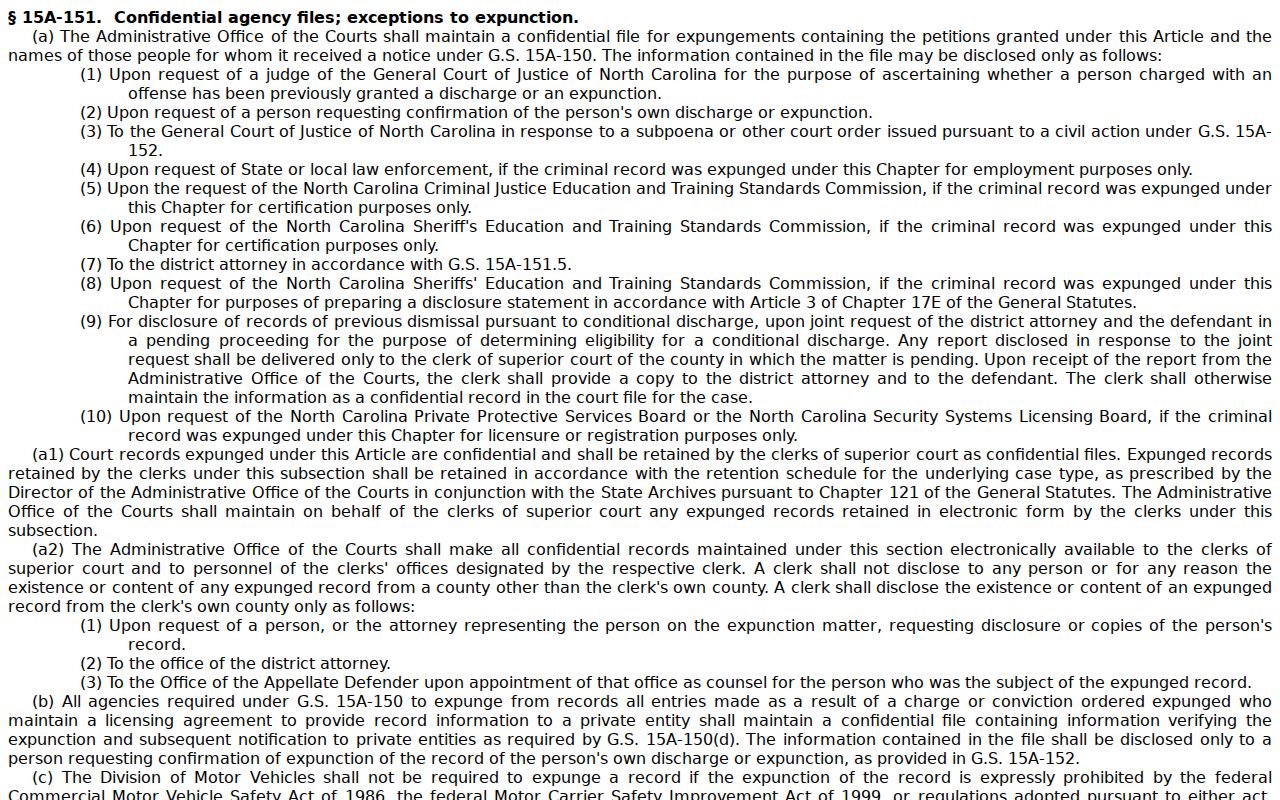
For a public Transylvania County criminal docket you can actually read, lean on the Case Summary, a current hearing result, the posted calendar, and the clerk. Working around a restriction is not the route to take.
Transylvania Criminal Docket Payment Boundary
The Portal's Make Payments option covers some criminal and infraction cases in Transylvania County. Eligibility depends on the case. Even when that option appears, use it with care. It does not replace a check of the Transylvania criminal docket. If the Portal will not take a payment, the deadline still stands. Payments cannot be pushed back. A failed online route is no excuse. For a payment that will not go through, the county clerk and cashier are the people to ask.
File & Serve is a separate tool. It handles North Carolina electronic filing, not docket searches or payment confirmations. Need a public court record? Turn to the Portal, the clerk terminal, or the Clerk of Superior Court.