
How to Get Court Records
Try the North Carolina eCourts Portal first when a public case summary, a hearing date, or an available document will answer the question. Keep its limits in mind. The Portal is a reference channel, not the official record. For a court-file copy, a certification, a paper file, or an availability question, go to the Transylvania Clerk of Superior Court. The state's Obtaining Court Records instructions point you to the clerk in the county where the case was filed.
Verified local channels are the clerk's counter, the public self-service terminal in the clerk's office, and the clerk's published phone line. The County's payment information covers mailed payments to the clerk. It does not set up an online case-copy order form or a routine mail-copy process. Call before you send payment or a request. The office can then tell you what public record exists, whether you need a plain or certified copy, the charge, and how delivery or pickup works. The official Transylvania sources list no separate public records email, local copy form, identification rule, or turnaround promise.
- Identify the court case by record number if known, plus the parties and the document or docket portion needed.
- Use the Portal for a public Case Summary or available document; use Search Hearings only for a date-focused question.
- Call or visit the Transylvania Clerk of Superior Court for a local file, paper copy, certification, or public-terminal access.
- Ask the clerk to confirm public availability, the correct product, payment method, and the statutory charge.
- Use the NCAOC public-records form only for Judicial Branch administrative records, not for a Transylvania case file.
Transylvania Court Record Counter
The Clerk of Superior Court is the county custodian for Superior and District Court records. That one office covers a wide range in Transylvania. Civil, criminal, estate, special-proceeding, and probate work all sit with the clerk. A case that began in District Court, or before a magistrate, has no separate county-court records custodian. For an official court-file copy, use the clerk's counter. The counter is also the local route for a case-specific question a public screen cannot answer.
Transylvania Clerk of Superior Court
Transylvania County Courthouse
7 East Main Street
Brevard, NC 28712
Monday-Friday, 8:30 a.m.-5:00 p.m.
(828) 885-3000
The Transylvania contact directory publishes the clerk's main number. The courthouse listing also notes public access and building information. No separate records email appears there, so do not assume an address.
Types of Court Records
A court docket is the running index of the case. Behind it sits the court file. That file can hold the pleadings, orders, judgments, and available exhibits. A certified copy is different: the clerk authenticates it under the clerk's authority. A transcript is its own product, made by a court reporter or transcriptionist. These names matter. Each item has a different source and a potential fee.
- Register of Actions or Case Summary, the public docket-style case index
- Pleadings, motions, orders, judgments, and other case-file documents
- Plain copies and clerk-certified copies of available public items
- Estate and special-proceeding records kept within the county clerk system
- Transcripts and certain qualifying audio products through their separate channels
The Portal may display a public document or document image when the system holds one. It does not promise online access to every filing, exhibit, or attachment. For a Transylvania file, the clerk gives the case-specific answer.
Transylvania Court Record Products
Choosing the right record product saves you a wasted request. A Portal Case Summary gives a near-real-time public view of the Register of Actions. But it is not the official record. A plain copy is a clerk-provided copy of an available public item. A certified copy adds the clerk's authentication. An exemplification is a higher form of authentication listed in the clerk-fee statute. Transcripts come from the official court reporter or transcriptionist, who sets transcript charges independently.
The state records guide draws this division clearly. It also notes that a District Court criminal nonfelony plea is not always recorded. That applies unless a judge orders recording. So a docket entry, a paper copy, a transcript, and an audio request are not interchangeable products.
- Register of Actions
- The Portal’s public summary of chronological court events.
- Certified copy
- A clerk-issued copy authenticated for the county where the case was filed.
- Exemplification
- A higher-form record authentication that has its own statutory fee.
- Transcript
- A verbatim record ordered from a reporter or transcriptionist, not from the docket search.
What a Court Record Contains
Exact contents depend on the case and the record type. The public Portal Case Summary works as a practical index. It can cover Case Information and assignments. Parties, events, dispositions, hearings, financial information where applicable, and permitted documents may appear too. The court file behind that summary may hold the materials that created the entries. Whether you can see each item depends on public-access rules and the record's availability.
| Case number | The identifier used to locate the file and Portal Case Summary. It is the most useful detail to give the clerk. |
|---|---|
| Pleadings and motions | Filed requests, responses, and motion papers that are public and available for release. |
| Orders and judgments | Signed rulings, final judgments, and other public court orders. |
| Register of Actions | The dated sequence of public filings, settings, orders, and dispositions. |
| Documents and exhibits | Available public materials, subject to sealing, redaction, confidentiality, and system limits. |
The records-access page lays out how to reach court records through public terminals and the clerk. It is also the official page behind this Transylvania County court-records image.
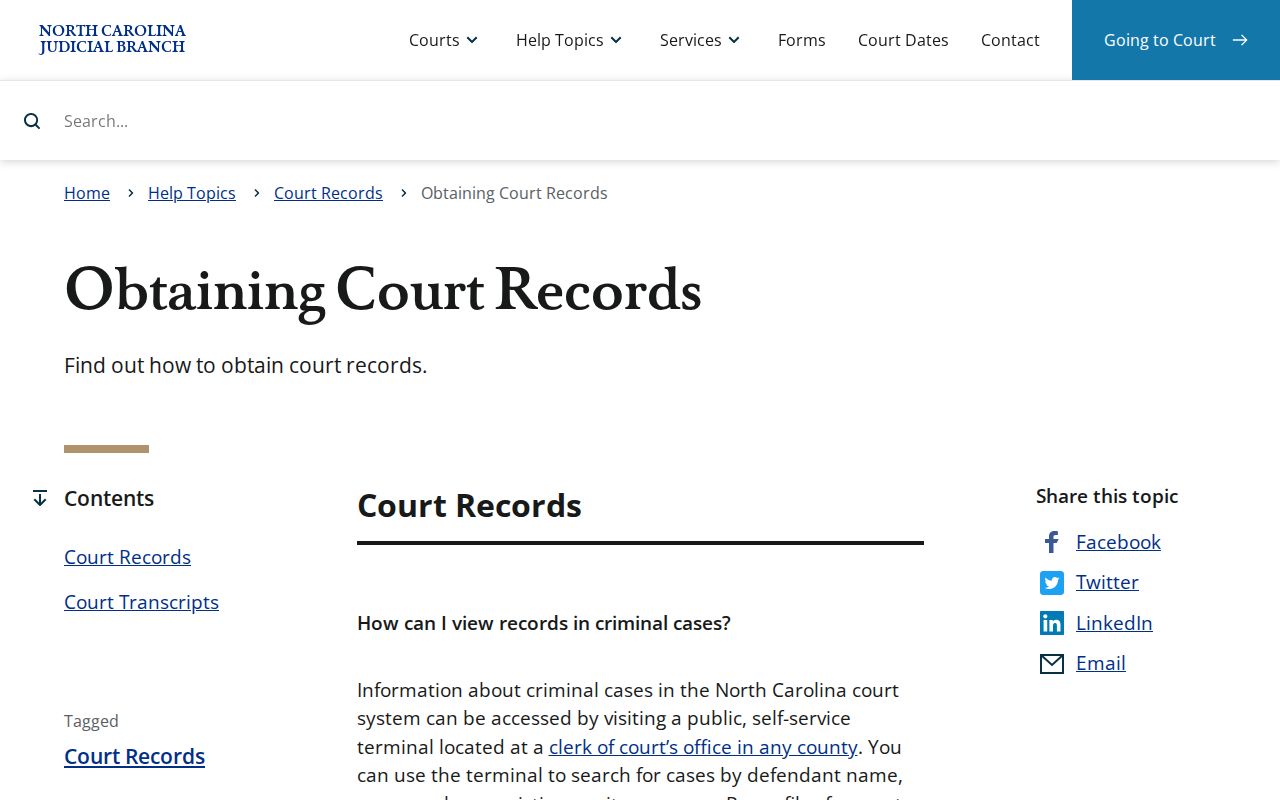
The statewide terminal guidance helps you locate a record. The Transylvania clerk then handles the local file and any copy request.
Transylvania Court Record Terminal
Every clerk's office has a public self-service terminal. You can search criminal, civil, special-proceeding, and estate records there. When an online Portal result looks incomplete, the terminal is a useful fallback. The courthouse counter can address an available paper file. None of this gets around confidentiality rules. A sealed, expunged, juvenile, or otherwise restricted item stays restricted. That holds even if you ask at the counter.
The terminal and the local file serve different roles. The terminal helps you identify public information. The clerk decides whether the local material you want may be inspected or copied. For the physical clerk location, the official Transylvania courthouse page is the current source. No local digitization cutoff is stated. And there is no promise that all older paper records appear online.
Certified Copies and Fees
The clerk-fee statute breaks copying charges into separate pieces. Certification costs one amount, exemplification another, and plain copies a third. So a certified packet from Transylvania County can carry more than one line item. The figures below are the statutory fees themselves, not a quote for your request.
The same statute also sets a $25 fee for a criminal-record search. That is a distinct service. It is not the price of every court-record lookup or copy. Don't treat it that way.
| Statutory item | Amount |
|---|---|
| Copy preparation, first page of each document | $2.00 |
| Each additional page or fraction | $0.25 |
| Certificate under seal | $3.00 |
| Exemplification | $10.00 |
| Criminal-record search, distinct listed service | $25.00, subject to statutory exceptions |
Start with the law. N.C. Gen. Stat. § 7A-308 gives the clerk authority to charge for copies. Ask the clerk to quote the document, its page count, any certification you need, and the final total before you pay.
For mailed payments, the county payment-information page accepts only a money order or certified check. No cash or personal check by mail. At the cashier window you can use cash or a card (processing fees apply). A money order or certified check works there too. One caution: that page covers court payments. It does not confirm every option for every copy order.
The official fee statute page is the source for the court-records image that follows.
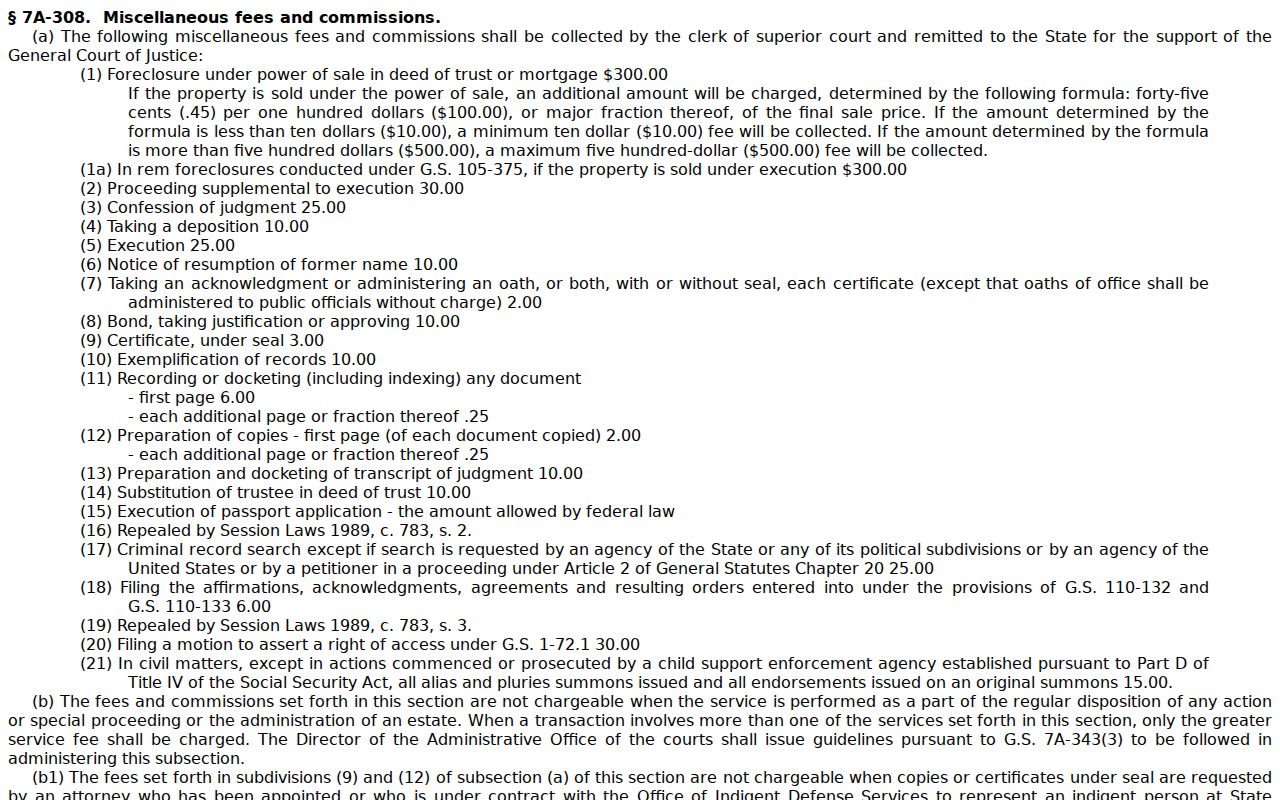
Treat the fee schedule as a prompt, not a price tag. It helps you ask the Transylvania County clerk a precise question about your court record, and the clerk supplies the case-specific quote.
Transylvania Court Audio Requests
Form AOC-G-114 covers one narrow task. That task is getting a duplicate of qualifying nonconfidential, electronically recorded District Court audio. It is not a general court-document request form. The form asks for the county, the case name or number, and the proceeding date. It also wants the judge, the courtroom, your contact details, and your signature. Confidential matters are out of bounds. Juvenile hearings are excluded too. On payment, the instructions call for cash, a certified check, or a money order payable to the clerk. Never use a personal check. The clerk sets the actual copying or media charge.
The AOC-G-114 form landing page spells out this qualifying audio route. It also links to the form itself.
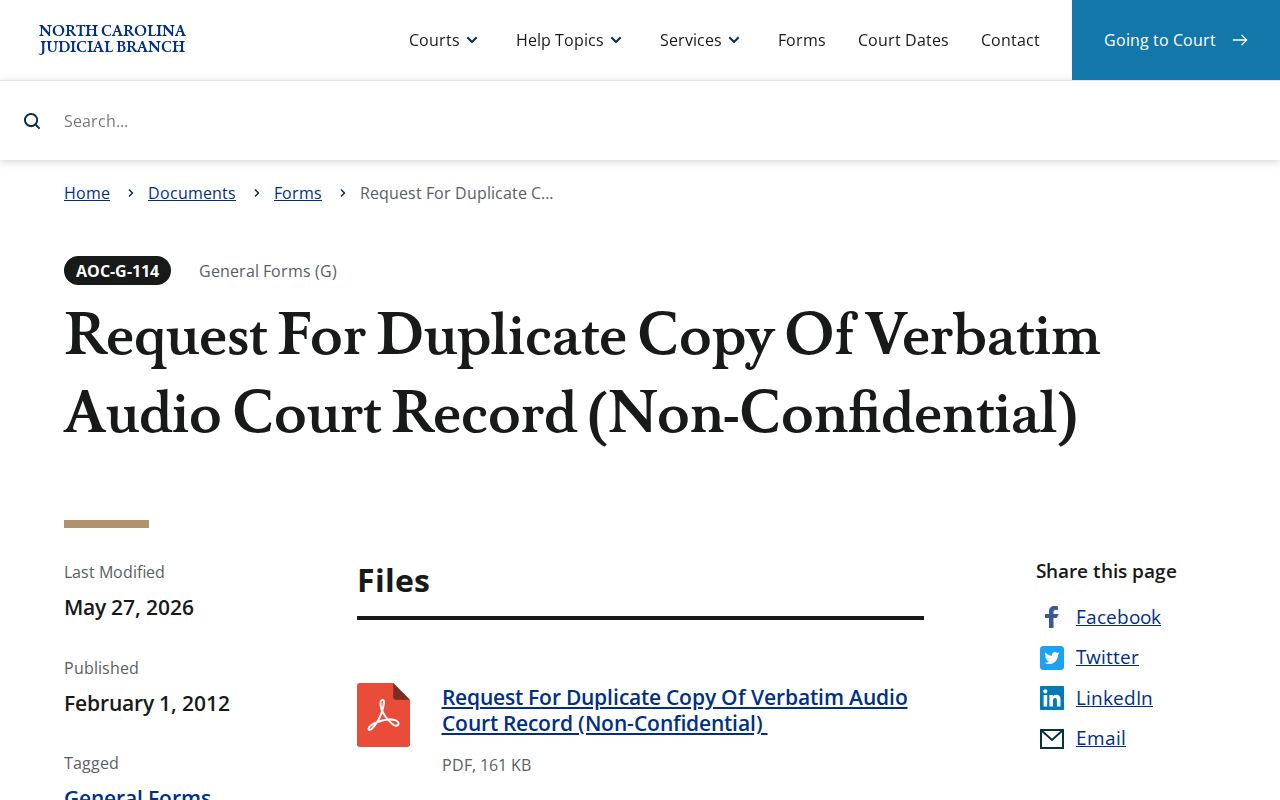
The audio form fits one purpose only: the particular nonconfidential District Court recording it covers. For a transcript, go to the reporter or transcriptionist instead.
Public Access and Sealed Records
North Carolina law puts the safekeeping duty on the clerk. The Transylvania County clerk maintains files, dockets, indexes, judgments, and related court records. Under N.C. Gen. Stat. § 7A-109, the public may generally inspect those records during regular office hours. That right yields only if some law restricts the material. A second layer of authority is the broader public-records statute, N.C. Gen. Stat. § 132-6. It backs inspection and copies. Even so, it cannot override court-specific rules on confidentiality, sealing, or access.
Key Rules:
N.C. Gen. Stat. § 1-72.1 provides a civil access procedure and does not automatically unseal a file.
Rule 27 seeks public filing where possible and ordinarily calls for a limited public redacted version when only part needs protection.
N.C. Gen. Stat. § 15A-151 keeps expunction materials confidential, while § 7B-3000 restricts juvenile files.
Restrictions do not lift because you switch interfaces. Rephrasing a request does not help either. For a Transylvania County court record, the right local question is simple: is this identified record public and open to inspection or copying?
Transylvania Court File Requests
Be careful where you send a file request. The NCAOC public-records form exists for Judicial Branch administrative records only. NCAOC states plainly that it is not the custodian of county case documents or case information. It will not fulfill a court-file request. So the form is no back door to a Transylvania County case file. For public reference information, use the eCourts Portal. For the actual file, go through the Transylvania Clerk of Superior Court.
The official NCAOC form page explains the form's scope. It also notes the form's limits for Transylvania court-records requests.
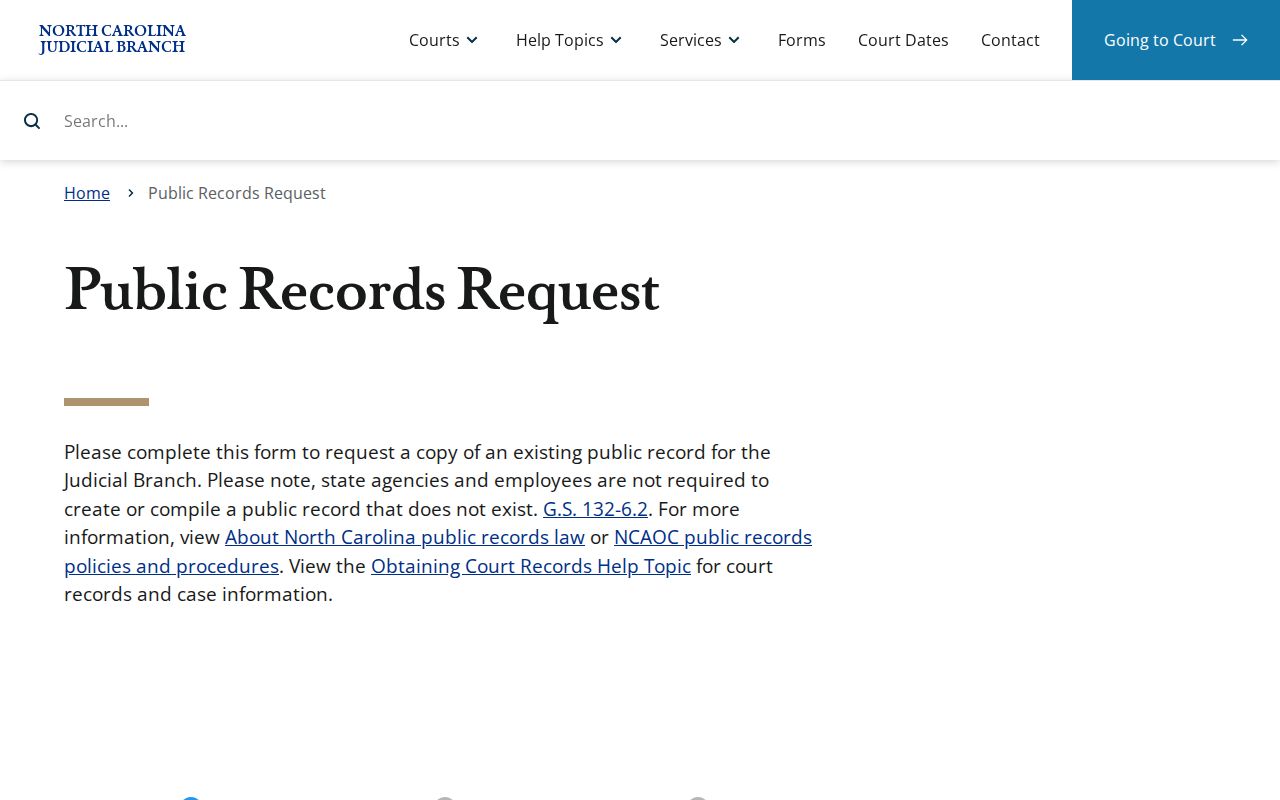
That administrative form has a real job, just not this one. Nothing about it replaces the county clerk's custody of Transylvania court records.
Older Transylvania records raise practical questions. Official sources confirm where the clerk sits today. But they publish no county-specific earliest online-coverage date, no paper-record cutoff, and no turnaround promise. Give the clerk the best identifier you have. Then ask which public record product can actually be supplied.
Transylvania Court Record Custodian
The Transylvania Clerk of Superior Court holds the local case files. Dockets, indexes, judgments, and the files of both Superior and District Court all live with that office. The statewide Administrative Office of the Courts plays a different role. It runs the eCourts tools and answers requests for its own administrative records. But it never holds a Transylvania County case file. Knowing that split matters. It tells you at once whether a request belongs with the clerk or with an NCAOC process.
Transylvania Court Record Copy Choice
A plain copy and a certified copy are two different products. The clerk authenticates the certified one under official authority. The plain copy carries no such certification. An exemplification sits higher still, with its own statutory charge attached. Before ordering any packet of Transylvania County court records, nail down the basics. Identify the case and the document. Note the page count if you know it. Also decide whether you truly need certification.
Transylvania Court Record Request Details
The court publishes no Transylvania-specific online form for an ordinary file copy. Nor does it guarantee a turnaround time, an ID requirement, or a local fee calculator. What makes a request land well is detail. Give the record number and the parties. State the document or docket portion you need. Say whether you want a plain or certified copy. From there the Transylvania County clerk can flag public availability and quote the applicable charge.
Transylvania Court Record Restrictions
Public inspection rules have limits. They never override sealing, redaction, juvenile confidentiality, expunction confidentiality, or any other legal restriction on a court record. A public terminal will not open protected material. Neither will a counter inquiry or a different online query on the docket. The lawful question for a specific Transylvania County court record is whether the item may be inspected or copied. It is not how to work around a restriction.
Transylvania Court Record Payment Caution
Payment rules for the Transylvania Clerk deserve a careful read. By mail, the county payment page allows only a money order or certified check. Cash and personal checks are off the table for mailed payments. At the cashier window the options widen. Cash is accepted there. So are payment cards with processing fees, money orders, and certified checks. Remember what the page is about, though. Those published details govern court payments. They do not settle the terms for every record order, so ask the clerk to confirm payment and delivery instructions for your specific copy request.