
How to Search the Transylvania County Court Docket
Start with the North Carolina eCourts Portal. Its Smart Search tool looks up public matters several ways. Party name, record number, citation number, attorney information, business name, case cross-reference number, even a nickname all work. A name or record number is the simplest starting fact. Searching by charge or offense term is not supported for criminal matters. When you want results limited to this county, select Transylvania as the location.
Portal results are reference information, nothing more. They never replace the record held by the Clerk of Superior Court. A result that comes back empty could mean a name-format problem, a filter, a restriction, a delayed image, or simply no matching public case. For any Transylvania County matter, the next stop is the local clerk or the public terminal at the courthouse.
- Open the Portal and choose Smart Search for a case or Search Hearings for a current court date.
- Enter the record number, citation number, or party name in the documented last-name, first-name form.
- Use Location to select Transylvania, then add a case type, status, or filing-date range only when it helps.
- Open the underlined record number to review the public Case Summary or Register of Actions.
- Contact the clerk for a public local file, a copy, or a certified record that the online display cannot provide.
Note: Narrow the search only after a basic name or record-number query gives you a workable starting point.
Transylvania County Portal Search Fields
The Portal is an Odyssey case-management access point rather than a separate county database. Its documented filters sharpen a county search, but a broad name query alone never settles anything about a person or case. For what the public can and cannot see, the Judicial Branch training materials walk through both the search functions and the access limits.
| Portal field | Use for a Transylvania search |
|---|---|
| Record Number or Name | Use a known number or party name as the basic Smart Search criterion. |
| Location | Select Transylvania to keep the result set within the county. |
| Case Type and Status | Apply after a broad result; an incorrect combination can hide a matching record. |
| Filing Date Range | Use a date range when the filing period is known but not exact. |
| Search Hearings | Choose a location, hearing type, search type, and date range for a current setting. |
The official eCourts information page describes the statewide system behind this public access path.
Statewide rollout is why the Portal is the right online layer for a current Transylvania County docket search. Certification of records, though, still happens locally.
What a Court Docket Shows
In the Portal, the docket-style case view is called a Case Summary or Register of Actions. It is a chronological public summary drawn from the clerk's record. Click an underlined case number and the panels may show identifying case information, assignment details, parties, events, dispositions, hearing information, financial information, and permitted documents. A panel appears only when the case and access rules allow it.
Treat a docket entry as a recorded court event, not the whole story. A hearing line shows a setting, not proof the hearing will happen as scheduled. A disposition label can summarize an outcome while later financial or post-disposition events stay open. And a missing image does not mean the clerk's file is empty.
| Case Information | Record number, type, status, and top-level filing details. |
|---|---|
| Assignment Information | Court, division, courtroom, or assignment data when recorded. |
| Case Events | Chronological filings, hearings, orders, and other recorded events. |
| Hearings | Scheduled public setting information that should be checked close to the date. |
| Dispositions | Recorded outcome or status data where entered and public. |
| Documents | Only public documents that are available in the system. |
Transylvania County Case Number Clues
A modern North Carolina record number usually pairs a two-digit year with a case-type code, a six-digit sequence, and a three-digit county identifier. Transylvania's code is 870. A non-identifying criminal example looks like YYCR######-870; an infraction example uses YYIF######-870. Formats only, not case references.
Older civil files may carry prefixes like CVD, CVM, or CVS. Those codes help describe a result you already have, but they cannot replace a name or exact record-number search. Portal guidance treats case-number searching as exact, and documented wildcards need enough leading characters before the asterisk. If the format is unclear, search by party name with the Transylvania location filter instead.
- Register of Actions
- The Portal's public, docket-style summary of case entries.
- Setting
- A scheduled court appearance, not a guarantee that a trial or final result occurs that day.
- Disposition
- A recorded resolution or procedural outcome in the displayed case.
- Transferred to Superior Court
- A status showing movement from the lower trial division to Superior Court.
Which Courts Keep Dockets
North Carolina runs a unified General Court of Justice, so there is no separate formal Transylvania County Court. Superior Court and District Court both operate in Judicial District 42. The Clerk of Superior Court keeps the county's files, dockets, indexes, and judgments for local matters. Magistrates sit as District Court officials, and their limited work creates no separate clerk system.
| Court or officer | Docket covers | Where to start |
|---|---|---|
| Superior Court | Felony cases, civil matters over $25,000, and District Court criminal appeals. | Portal, then the Transylvania Clerk for the official file. |
| District Court | Misdemeanors, infractions, family and juvenile matters, and civil cases of $25,000 or less. | Portal, Search Hearings, county calendars, or the clerk. |
| Magistrates | Small claims and limited preliminary criminal functions within the District Court system. | Portal or the same county clerk structure. |
| Appellate courts | Appeals beyond the trial-level county docket. | North Carolina Court of Appeals or Supreme Court materials, as applicable. |
The North Carolina court-types overview describes the statewide hierarchy behind those local docket paths.
The hierarchy still matters. Knowing a case's division is often the fastest way to tell which calendar and records channel applies.
Transylvania County eCourts Transition
Transylvania joined the Track 5 eCourts rollout on July 22, 2024. The technology paired the public Portal with Enterprise Justice and a separate File & Serve filing channel. North Carolina later reported statewide conversion. Even so, a statewide search interface never moved the official county file away from the local clerk.
Older case activity can demand careful reading after conversion. The Portal FAQ warns that some legacy events display a time of 12:00 a.m. because of conversion, not because anything actually happened at midnight. That is display context, not evidence of a precise event time. When an older entry affects a present question, ask the clerk about the public local file.
The official Track 5 rollout notice named Transylvania among the western counties scheduled for the change.
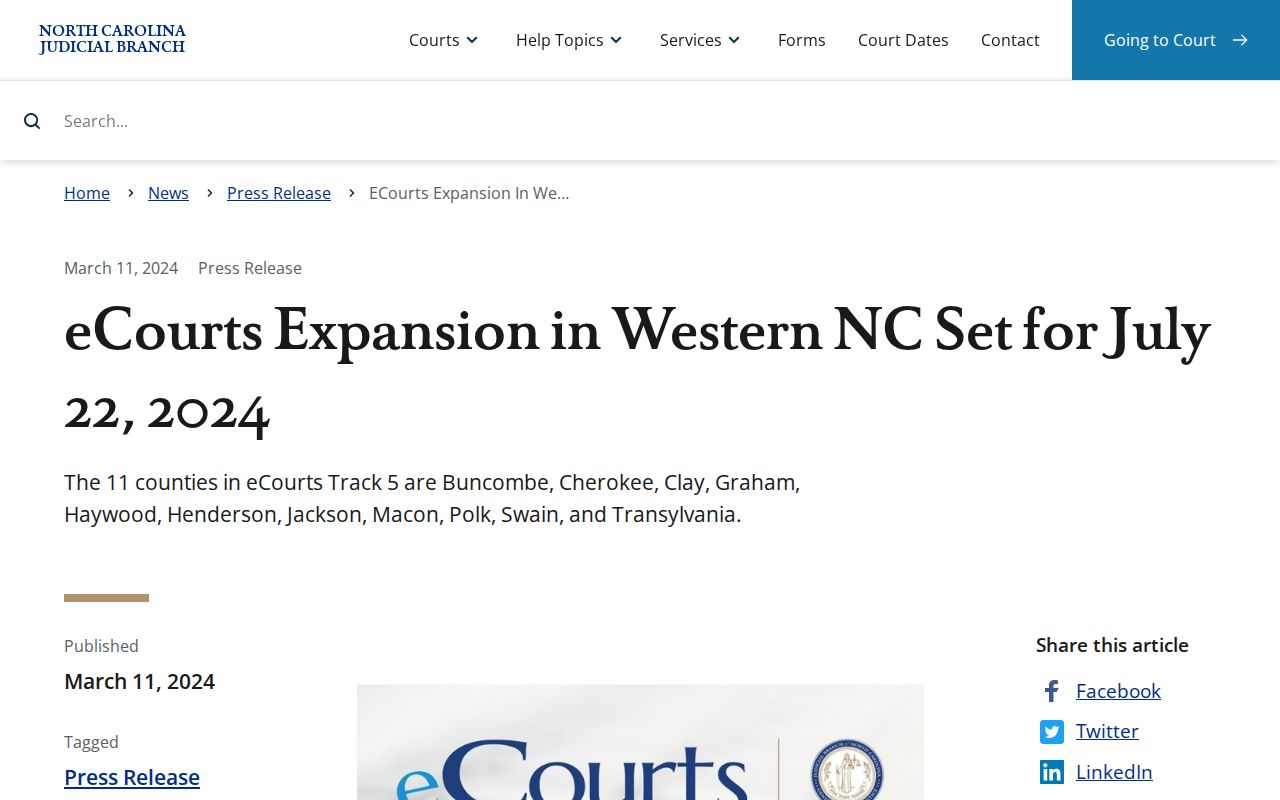
The rollout notice is context for today's search route. The clerk remains the record custodian for Transylvania County cases.
The Judicial Branch also published a Track 5 transition timeline covering the conversion period.
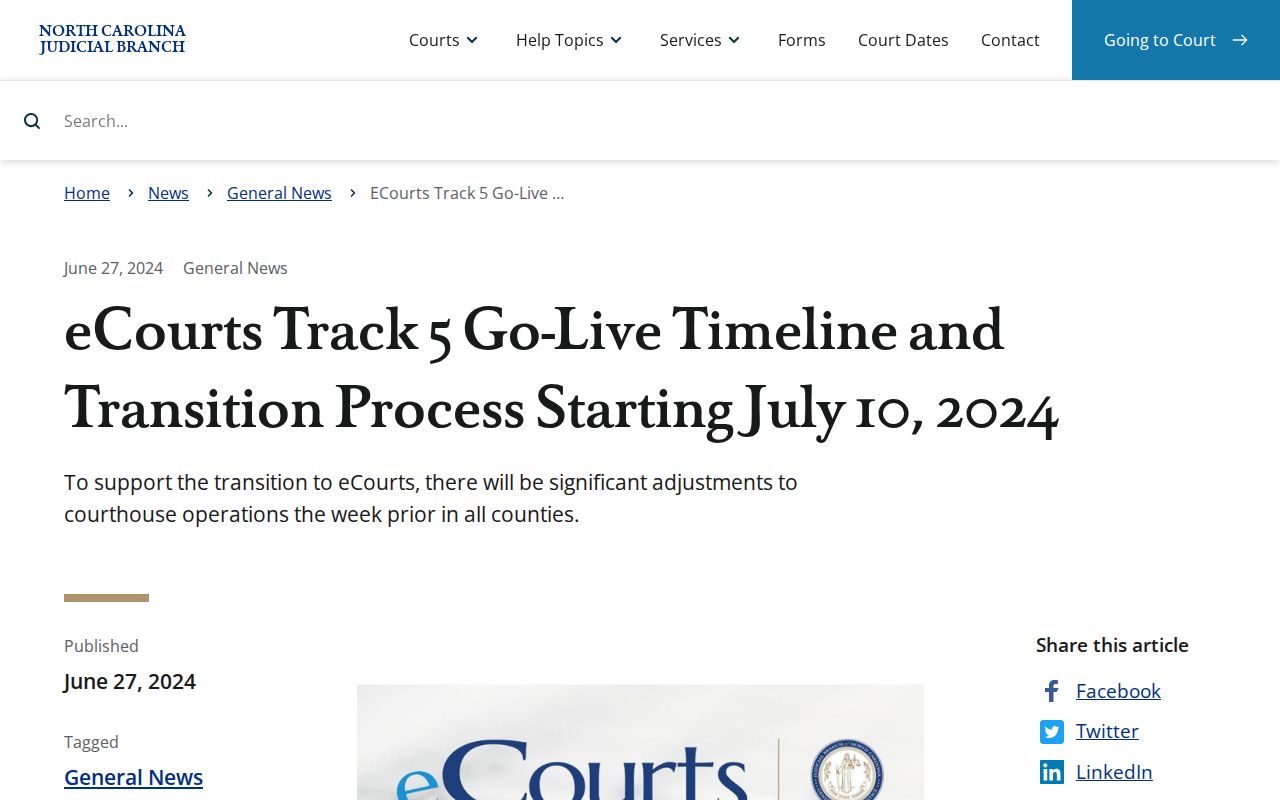
That timeline is a good reason to check the record itself rather than trust a legacy timestamp with no context.
Finding Court Dates and Settings
Need a date for one case? Start with Portal Search Hearings. Set the Location to Transylvania, pick the hearing type the service lists, match it to a search type, and enter your value with a start and end date. The state's Find My Court Date service points the public to this same Portal route.
Posted calendars give useful context. They do not replace an individual hearing result or a court notice. The civil calendar and criminal calendar pages group their posted files by court level. If a date seems off, is missing, or changed after a closure or continuance, confirm it with the clerk. The Transylvania County court calendar page walks through the process in more detail.
Transylvania County District 42 Schedules
The county's Local Administrative Schedules page pulls together quarterly schedules, calendar files, and the Portal. District 42 grids can list Henderson, Polk, and Transylvania. So check where court is actually sitting, not just the county name on a document.
One published abbreviation carries a defined meaning. FA/NDV stands for First Appearances and NEW 50Bs ONLY. Don't guess at the other compact labels. A schedule shows assignments. The hearing result on the record and a court notice still confirm an individual setting best. The official Transylvania County court location page posts the current county links and quarterly materials.
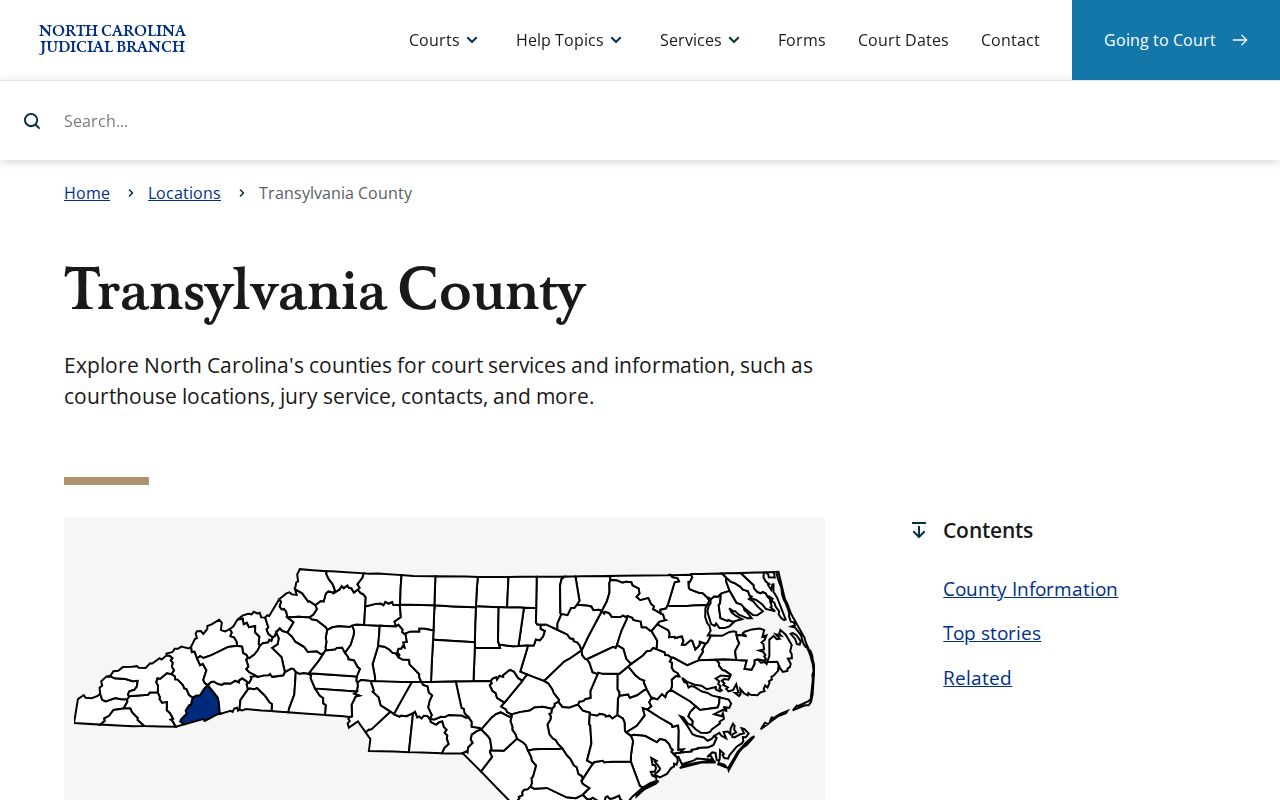
The county location hub groups the schedule route with local court contacts, payment information, and other docket-related services.
Public Access to Dockets
North Carolina law opens the clerk's files, dockets, and indexes to public inspection during regular office hours. Another law can restrict them. That baseline has limits, though. It does not put every document online or override a sealing order. Use the Portal for a quick public reference. For inspection, public copies, or certified copies of a Transylvania County court record, go to the clerk's office.
Key Rules:
N.C. Gen. Stat. § 7A-109 requires clerks to keep court records and provides the basic public-inspection rule, subject to legal restrictions.
N.C. Gen. Stat. § 132-6 supplies a general inspection-and-copying rule, but it does not replace court-file access limits.
N.C. Gen. Stat. § 1-72.1 sets a civil procedure for a person asserting an access right; it is not an automatic unsealing rule.
N.C. Gen. Stat. § 15A-151 protects expunction files from ordinary public access.
The official docket statute is the source for the clerk's recordkeeping and inspection baseline.
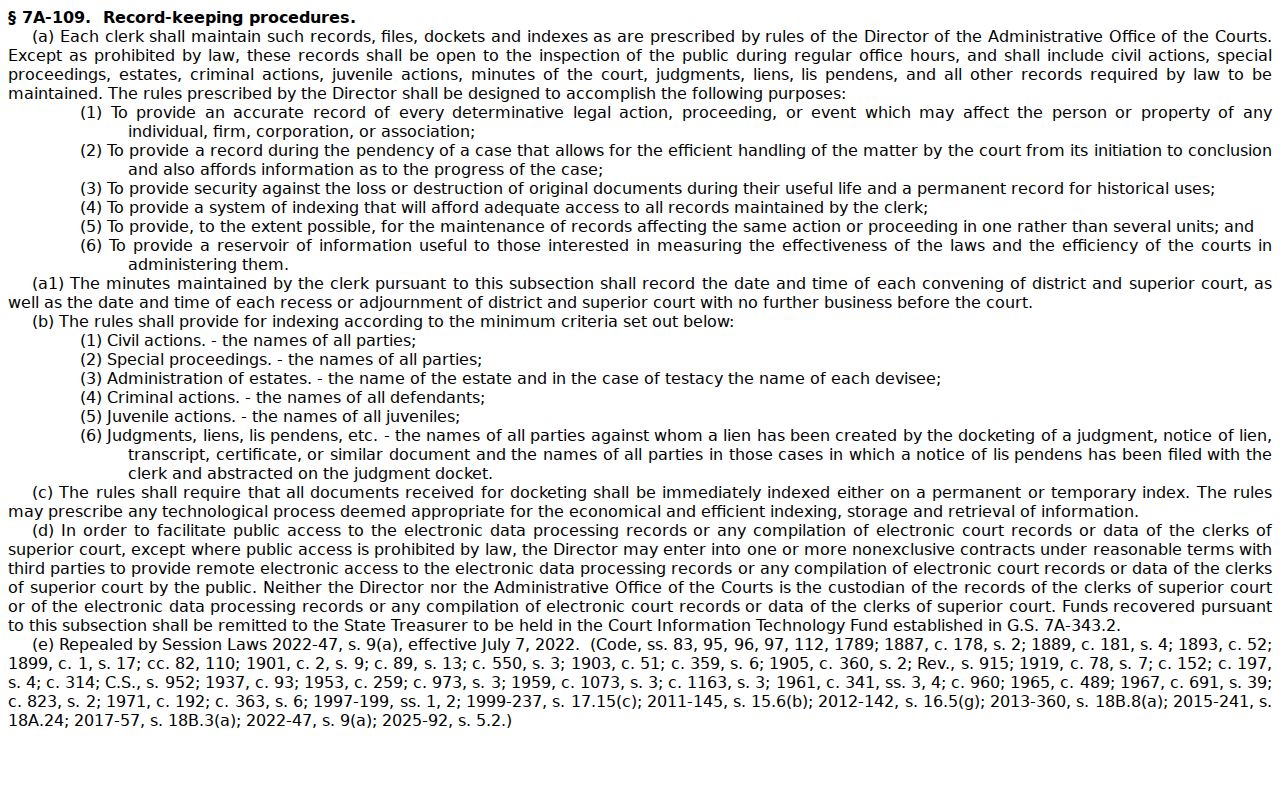
The rule keeps public court records open while shielding confidential material from any docket search.
Restricted Transylvania County Docket Records
Some Transylvania County docket records stay off ordinary public searches. State law treats juvenile delinquency and undisciplined-juvenile files that way. Expunction material is confidential. A court can seal records or order redaction. Online access to some domestic-violence information is narrower than counter access. An unreturned criminal warrant is another record hidden from ordinary public Portal users.
Keep these categories separate. A no-result proves no expunction, no legal outcome, and no absence of a case. It may stem from the search term, record format, location filter, processing, or an access limit. Ask the Transylvania Clerk of Superior Court the right question. Ask whether a particular public record may be inspected or copied, not how to get around a restriction.
Note: the public Portal excludes victims from its search results. It also masks more personal detail than the clerk's official file may contain.
The Clerk and Docket Records
The Clerk of Superior Court keeps Transylvania County records, files, dockets, indexes, and judgments. Those cover Superior and District Court matters. A Portal result may be incomplete. A paper file may be needed. A certified copy may be required. In each case the official court-file route runs through that office. Clerk offices also offer a public self-service terminal under statewide court-record guidance.
Know the fees. Statewide charges run $2.00 for the first page of each document. Each additional page is $0.25. A certificate under seal costs $3.00. An exemplification is $10.00. A $25 criminal-record search is a separate statutory service, not the price of every docket lookup. Ask the clerk to quote the charge for your specific record, page count, and certification.
Transylvania Clerk of Superior Court
Transylvania County Courthouse
7 East Main Street, Brevard, NC 28712
(828) 885-3000
Monday through Friday, 8:30 a.m. to 5:00 p.m.
See the official courthouse page for the building's listed public access details.
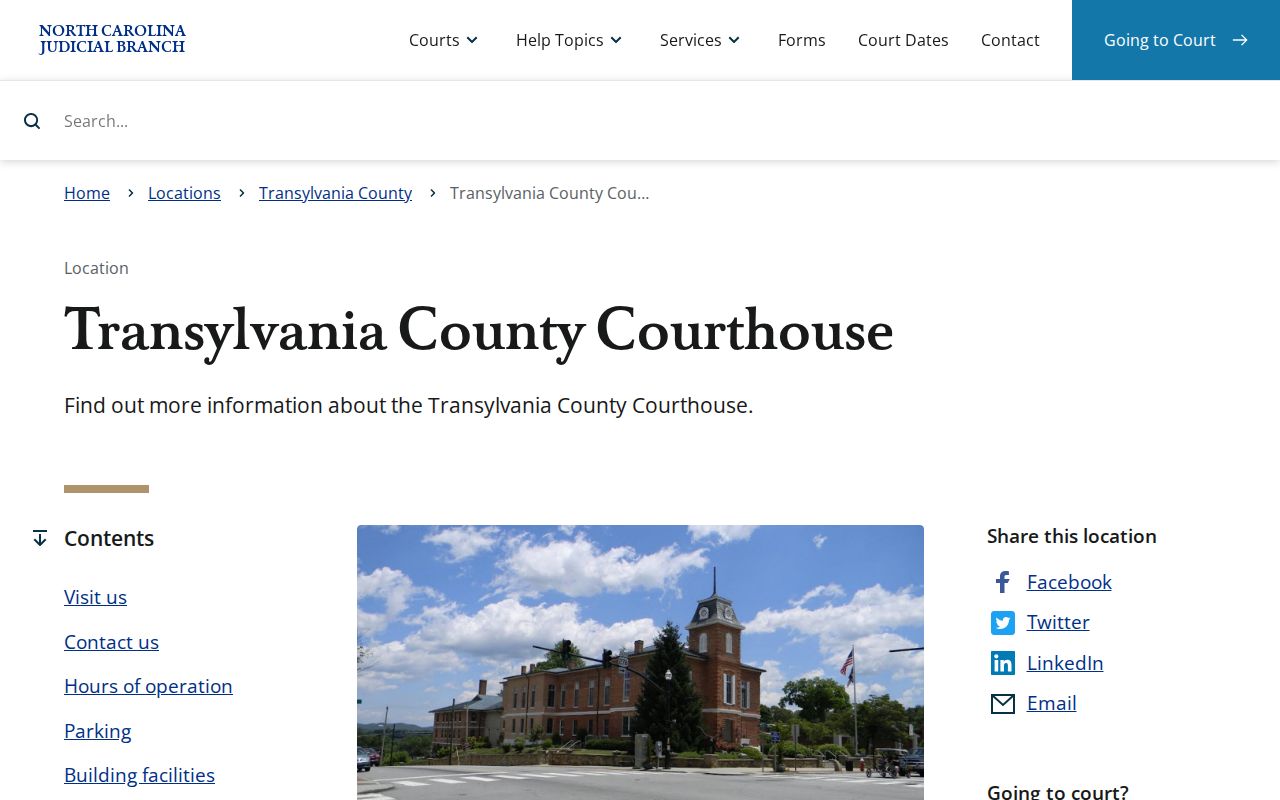
The courthouse is the confirmed county location for local file questions, clerk-assisted copies, and certified records. The Judicial Branch also posts a county court contact directory with clerk, court, district attorney, reporter, and magistrate office numbers.
Those office contacts help route a local question without treating a non-clerk office as the keeper of the court file.
Transylvania County Docket and File
A Portal Case Summary is a strong tool. It lists public events, hearing information, and available documents. It is not the official record. The official file may involve a paper record, a certified copy request, a transcript issue, or an audio-record process that needs local handling. The court-records guidance sends a requester to the clerk in the county where the case is located.
| Need | Best verified route |
|---|---|
| Public case summary or event history | Portal Smart Search and Register of Actions. |
| Current hearing lookup | Portal Search Hearings, then the clerk if the result conflicts with notice. |
| Public local file or ordinary copy | Transylvania Clerk, clerk counter, or public terminal. |
| Certified copy | Transylvania Clerk of Superior Court. |
| Administrative record held by NCAOC | NCAOC public-records process, which is not a substitute for county case files. |
Transylvania County Courthouse Context
Brevard is the county seat and home to the county's listed Judicial Branch courthouse. The county's historical timeline says the existing brick courthouse was approved in 1874. It still operates today. A facilities project has been in planning and development. But no new court location is up and running, so the current Judicial Branch courthouse listing remains the place to confirm clerk service.
In fiscal-year dashboard context, the Judicial Branch reported 4,588 filings and 4,639 dispositions for Transylvania County in FY 2025-26. Those are all-case county figures. They are not a count of people, city citations, or one court division. They explain why a docket search needs court, type, date, and county context rather than broad assumptions.
The county jury-service page is a separate court-service channel, not a docket search tool.
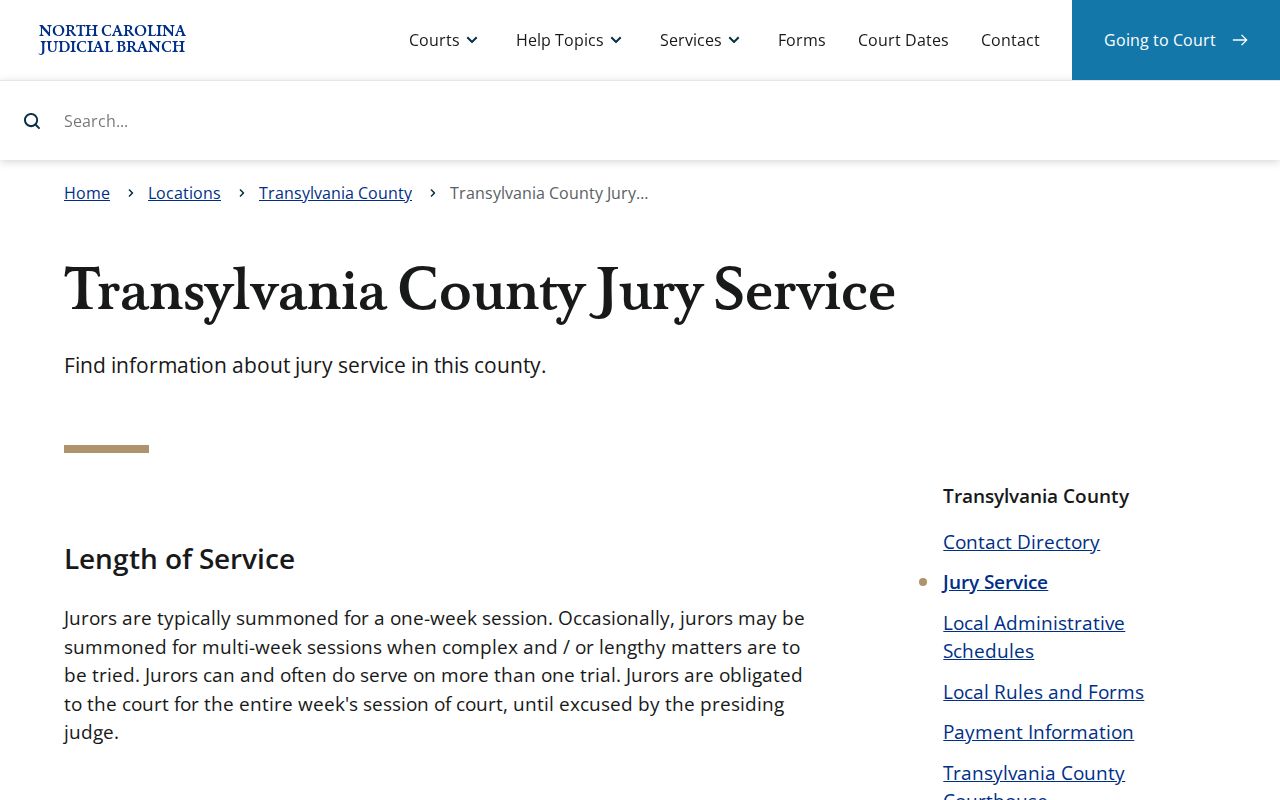
Jury duty and docket access both live inside the Transylvania County court system. They simply serve different needs for the public.
Court Dockets by City in Transylvania County
Transylvania County contains two incorporated cities: Brevard and Rosman. Neither one runs its own municipal court. There is no city judge. There is no separate city court docket. There is no local case-search portal for either town. A traffic ticket or criminal charge filed in Brevard or Rosman still travels the state route: District Court, the Portal, and the Transylvania Clerk of Superior Court. The city pages here sort out local government contacts from the correct state-court docket path.
Brevard Court Docket
Population 7,744 in the 2020 Census. Brevard has no documented municipal court; public case access follows the Transylvania state-court route.
Rosman Court Docket
Population 701 in the 2020 Census. Rosman has no documented town court; records route through the Portal and Transylvania Clerk.
Map and Directions to the Transylvania County Courthouse
Superior Court District 42 and District Court District 42 both conduct business at the Transylvania County Courthouse, 7 East Main Street in Brevard. The Clerk of Superior Court's office there is the unified custodian for felony and civil Superior Court sessions, District Court misdemeanors and traffic cases, estates, and the clerk's own probate work, covering both incorporated towns in the county.
Transylvania County Courthouse
7 East Main Street
Brevard, NC 28712
(828) 885-3000
Monday through Friday, 8:30 a.m. to 5:00 p.m.
Parking is available in the lot behind the courthouse and in public spaces across the street to its side, and the building has wheelchair access and elevators. A local order bars talking or texting in the courtroom itself and requires the presiding judge's consent before recording still or moving images there.